SELF-BUILT PRODUCT
NAVOTA
Film incentive analysis built for production decisions, not headline percentages.
Navota is a decision-support tool for film and television producers comparing incentive strategies before locking a production plan. It turns project details, including budget, shoot length, union status, local hiring, transferability, and recovery priorities, into comparable jurisdiction scenarios, estimated net recovery, timing, and compliance risks.
I conceived and built the prototype to address a specific failure in production planning: the advertised incentive rate rarely tells a producer what the incentive will actually be worth after qualifying-spend rules, exclusions, bonuses, transfer discounts, broker fees, recovery timelines, and filing requirements.
Role
Product concept, domain research, UX, report design, and AI-assisted build
Format
Decision-support web application and report generator
Status
Self-built prototype
Primary output
Comparative film-incentive analysis report
WHY I MADE IT
Film incentives can determine where a production shoots, how a budget is allocated, and whether a project becomes financially viable. Yet the information is usually published jurisdiction by jurisdiction, while the actual decision has to be made project by project.
A producer does not simply need to know that a state or country advertises a 25% or 40% credit. They need to know which parts of their budget qualify, what is excluded, whether the credit is refundable or transferable, what it may sell for, how long recovery could take, and which deadlines could eliminate the benefit entirely.
The headline rate is often the easiest number to find and the least useful number for making the decision.
The real question is not “Which jurisdiction offers the largest credit?” It is “What will this production actually recover, when, and at what risk?”
START WITH THE PRODUCTION, NOT THE JURISDICTION
Most incentive research begins with a location and explains the program available there. Navota reverses that structure.
The product begins with the production itself: what is being made, how much it costs, how long it will shoot, who will be hired, how the production can divide its work, whether credits need to be transferred, and how quickly the money needs to return.
Those inputs allow Navota to compare locations in the context of the same project rather than presenting a directory of disconnected programs.
The product is therefore not designed to answer, “What is the Georgia credit?” It is designed to answer, “What happens to this particular production if part of it moves to Georgia?”
KEY PRODUCT DECISION
Model the project first. Apply the incentive rules second.
THE INTAKE
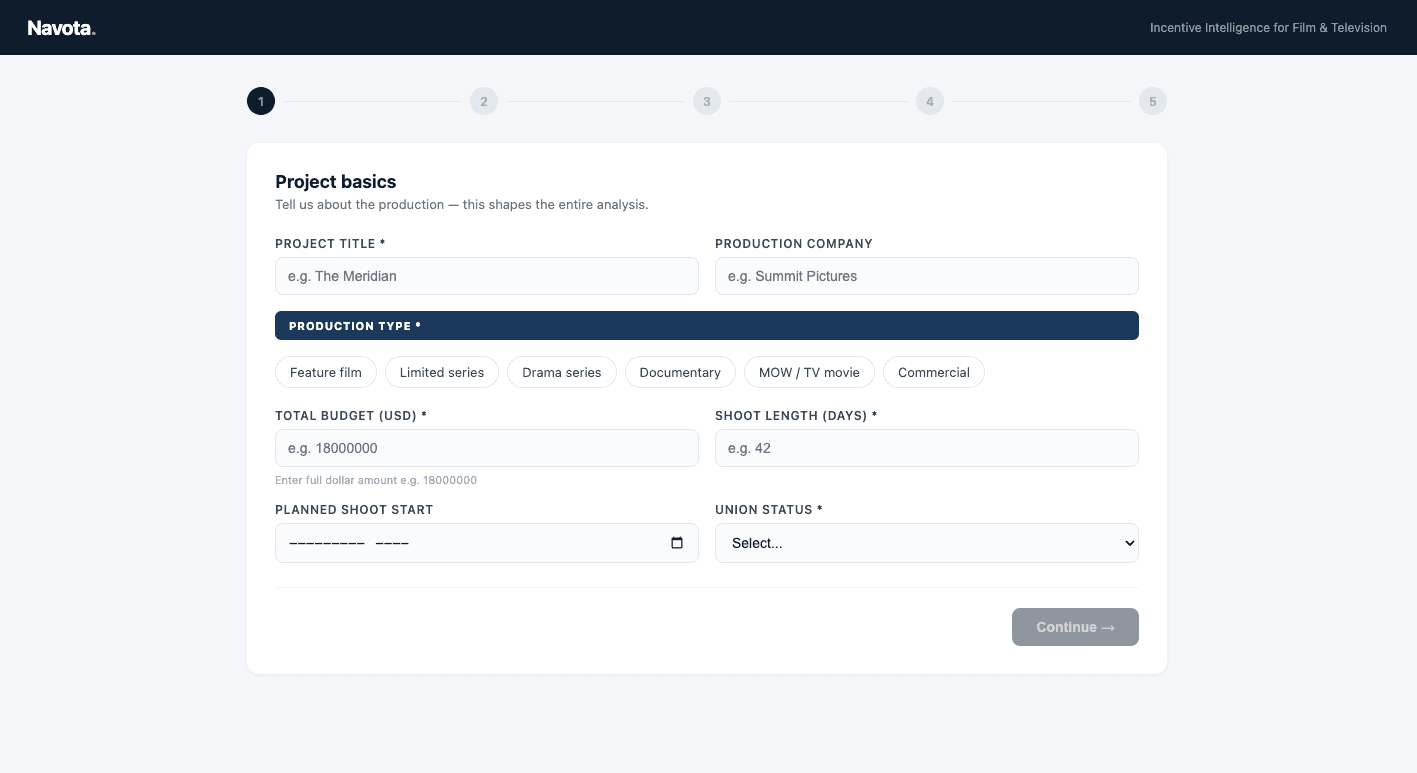
The intake translates a production plan into the variables that materially affect incentive eligibility and recovery.
The initial prototype asks for information such as production type, total budget, principal-photography length, union status, expected local hiring, preferred credit mechanism, and the production's recovery timeline.
The goal is not to reproduce an entire film budget inside the form. It is to collect enough structured context to produce useful scenarios while keeping the initial analysis accessible.
01
PROJECT
Production title and production type
02
SCALE
Total budget and principal-photography length
03
LABOR
Union status and expected local-crew percentage
04
LIQUIDITY
Preference for refundable, transferable, or otherwise monetizable credits
05
TIMING
How quickly the production needs to recover the incentive after wrap
06
PLANNING PRIORITIES
Existing location assumptions and the production's willingness to consider alternatives
HOW IT WORKS
Navota turns the intake into a sequence of comparable planning decisions. The product is designed to show not only which scenario produces the strongest estimated recovery, but why.
01
DEFINE THE PRODUCTION
Capture the scale, format, schedule, labor structure, and financial priorities of the project.
02
IDENTIFY ELIGIBLE JURISDICTIONS
Match the production profile against relevant incentive programs and eligibility conditions.
03
ESTIMATE QUALIFYING SPEND
Separate the portions of the budget that may qualify from excluded or location-specific costs.
04
BUILD COMPARABLE SCENARIOS
Create an anchored plan, a practical optimization, and a more ambitious alternative.
05
CALCULATE RECOVERY
Estimate gross credit, transfer or broker effects, net cash recovery, and the remaining production cost.
06
SURFACE RISK
Flag deadlines, thresholds, exclusions, cultural tests, local-hire requirements, and other conditions that could affect qualification.
07
VERIFY THE BASIS
Identify the primary program sources, the date checked, and the confidence level of each assumption.
THREE SCENARIOS, NOT ONE ANSWER
A production-location decision rarely has one objectively correct answer. The highest theoretical credit may require an impractical allocation, introduce additional compliance, delay recovery, or conflict with the creative and logistical plan.
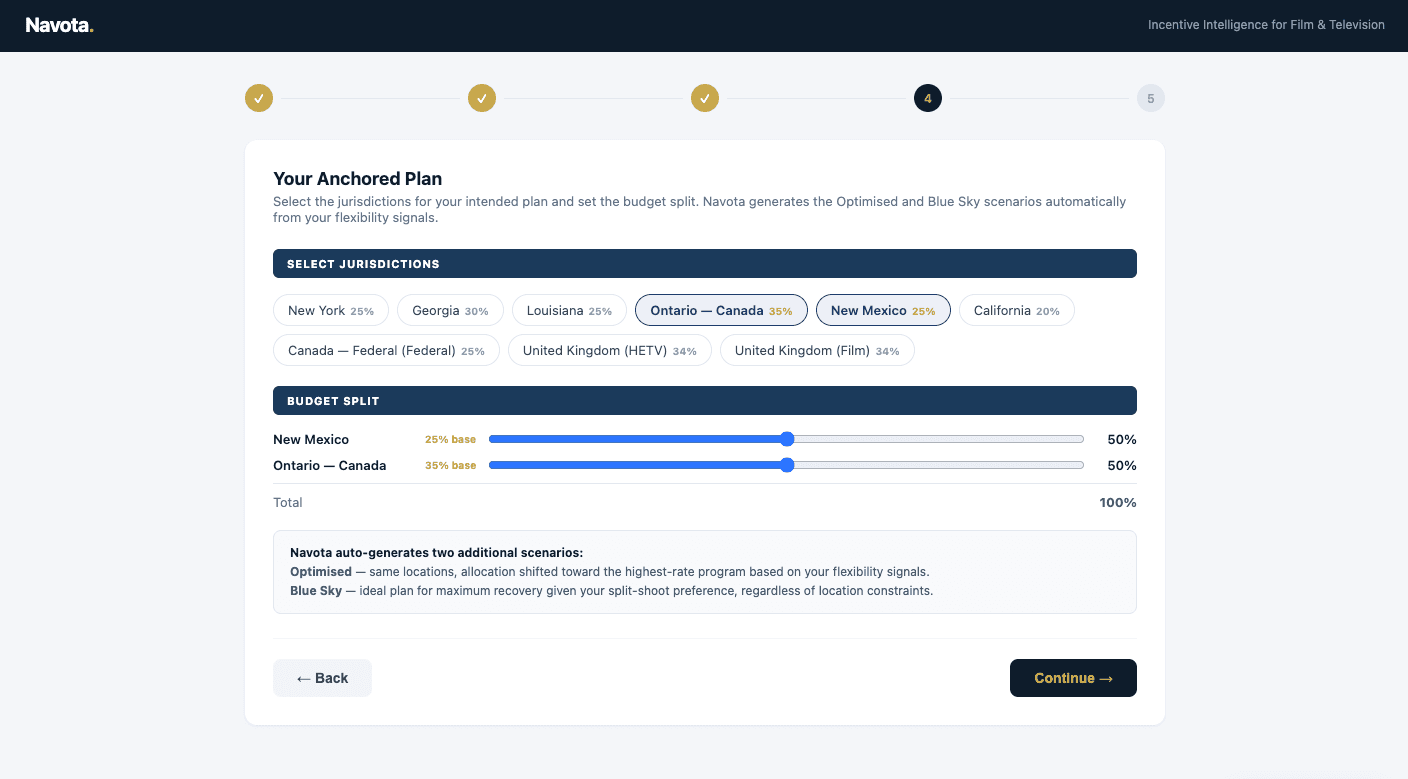
Navota therefore presents three scenarios rather than a single recommendation.
01
ANCHORED PLAN
Reflects the production's existing assumptions and shows the likely incentive outcome without materially changing the plan.
02
OPTIMISED PLAN
Reallocates eligible work where a realistic change could improve net recovery without turning the production into an entirely different operation.
03
BLUE SKY
Tests a more aggressive allocation to reveal the upper edge of the opportunity and the tradeoffs required to reach it.
The comparison makes the distance between the current plan and the theoretical upside visible. The producer can then decide whether the additional recovery is worth the operational change.
WHAT THE REPORT MAKES VISIBLE
The report is designed to separate the numbers that are often collapsed into one advertised percentage.
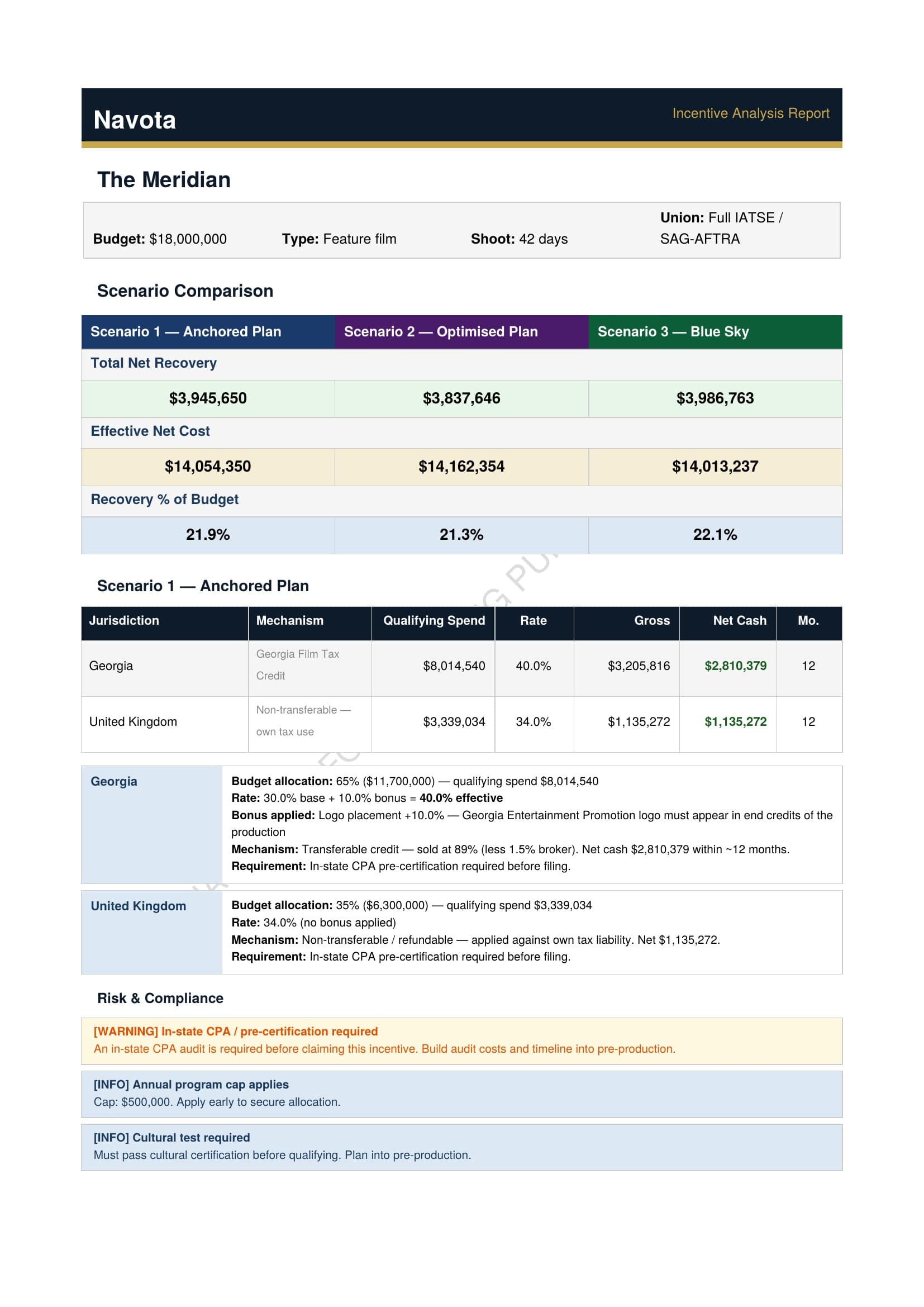
It shows the production-level result first, then allows the reader to inspect the assumptions underneath it.
NET RECOVERY
The estimated cash value remaining after the relevant transfer discount, broker cost, or refund mechanism.
NET PRODUCTION COST
The remaining production cost after estimated incentive recovery.
QUALIFYING SPEND
The part of the allocated budget expected to satisfy the jurisdiction's program rules.
RECOVERY TIMING
An estimate of when the production may receive or monetize the benefit after wrap.
BONUS CONDITIONS
Additional value tied to requirements such as local hiring, promotional placement, or other program-specific thresholds.
COMPLIANCE FLAGS
Deadlines, exclusions, minimum-spend rules, certification requirements, and other risks that could invalidate or reduce the incentive.
SOURCE CONFIDENCE
The primary source, verification date, and confidence level supporting each program assumption.
A useful financial tool should expose the assumptions underneath the answer.
THE REPORT AS A DECISION DOCUMENT
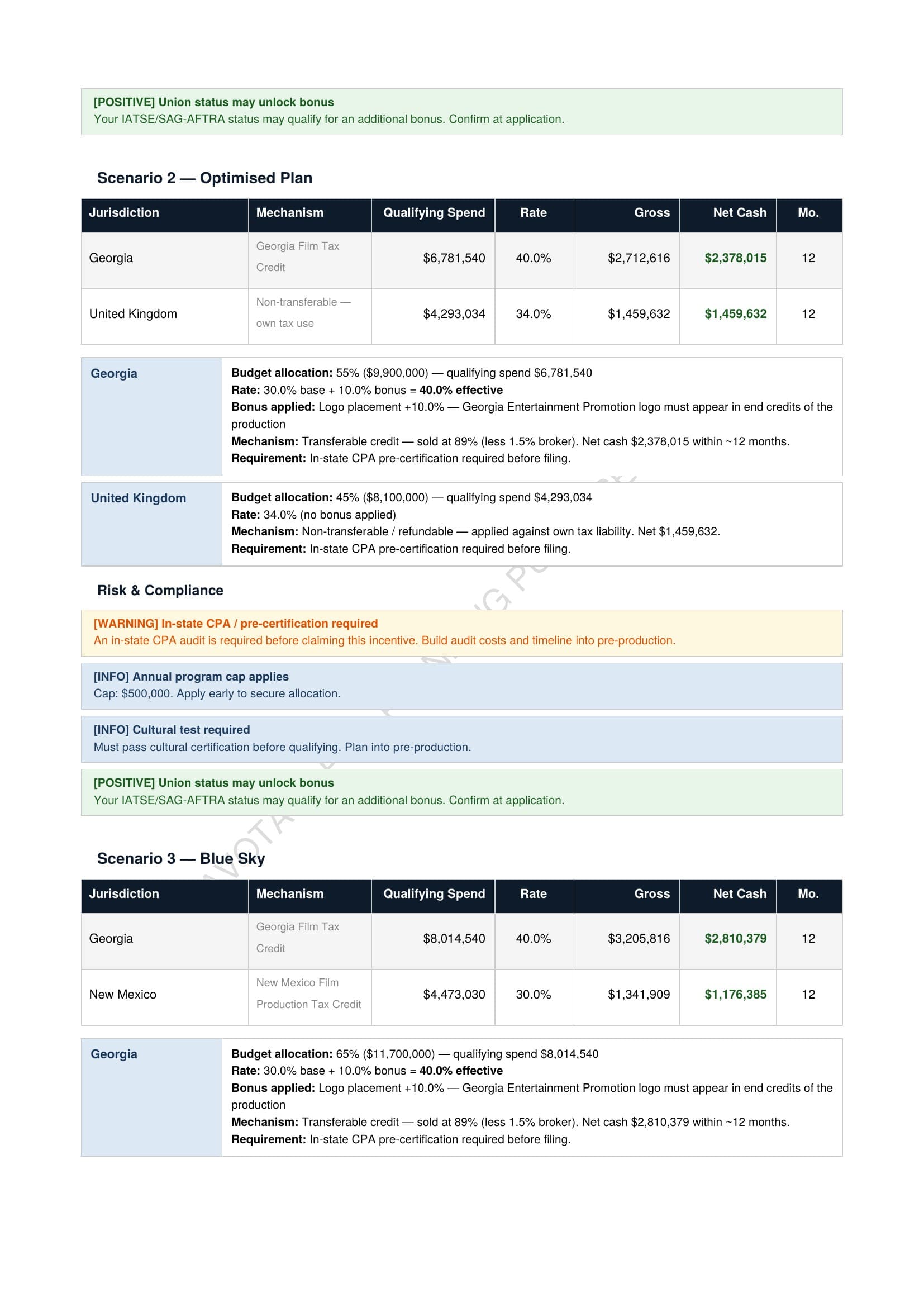
The example report models an $18 million feature film with 42 days of principal photography and compares an anchored, optimised, and blue-sky production plan across U.S. and United Kingdom jurisdictions.
The first page is intended for the decision-maker. It summarizes the project, places the scenarios beside one another, and makes the estimated recovery and remaining production cost immediately comparable.
The second page is intended for scrutiny. It breaks the selected scenario into jurisdiction-level economics, bonus conditions, transfer mechanics, estimated receipt timing, compliance risks, and source verification.
The report does not hide complexity, but it gives that complexity an order.
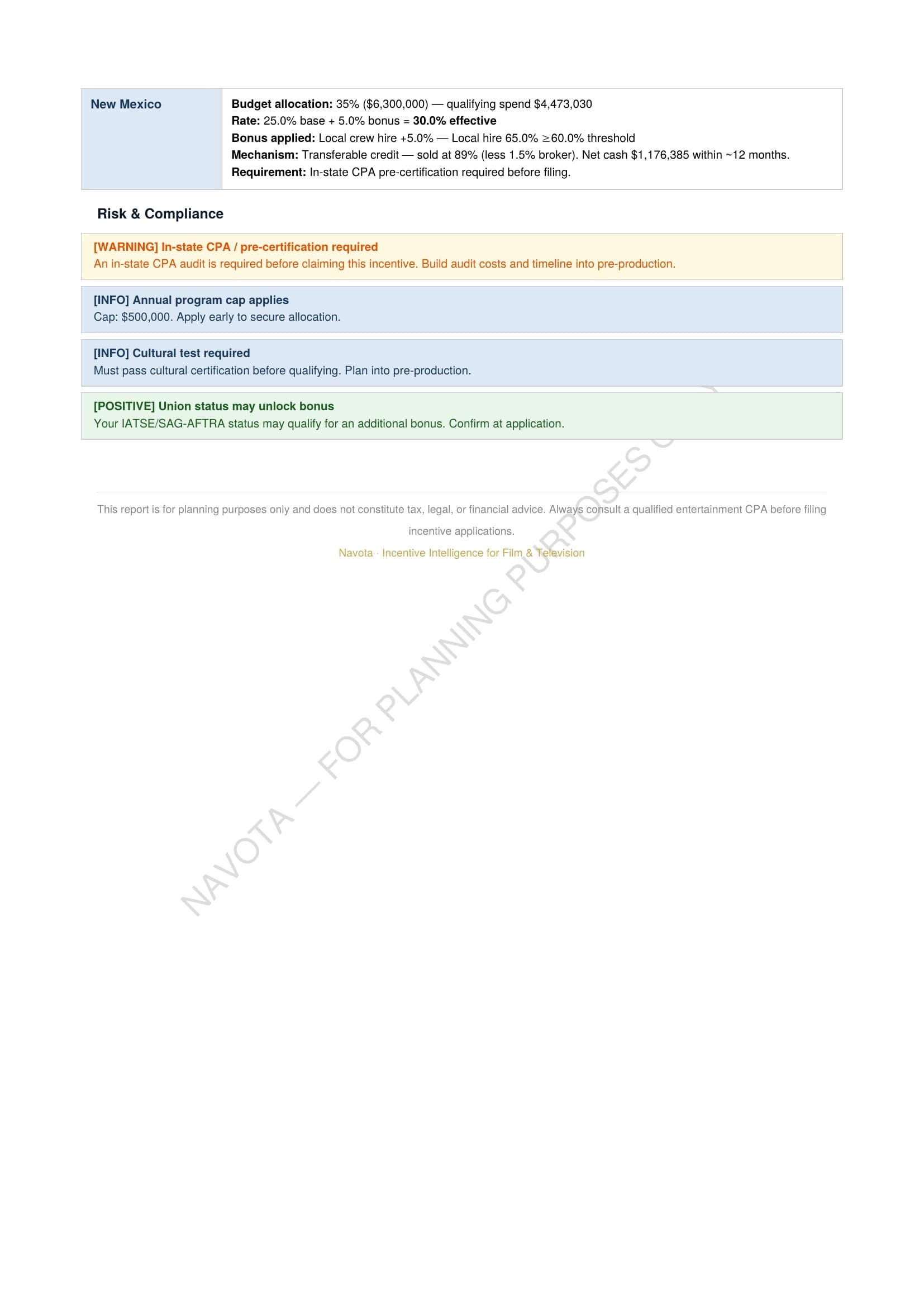
The detailed layer explains how the comparison was calculated and what could still change the result.
VIEW SAMPLE REPORT (opens PDF in a new tab)TRUST IS PART OF THE PRODUCT
Film incentives sit at the intersection of legislation, production accounting, government administration, and changing market conditions. A polished answer without visible provenance would be more dangerous than useful.
Navota therefore treats confidence, verification date, source type, and compliance risk as product information rather than legal fine print.
The report distinguishes between values verified against primary government or film-commission sources and estimates affected by market conditions, such as the price of transferring a credit.
It also makes the boundary of the product explicit. Navota can structure a decision, reveal assumptions, and identify questions that require professional confirmation. It cannot certify final eligibility or replace an entertainment CPA, attorney, film commission, or revenue authority.
PRODUCT BOUNDARY
Planning intelligence, not filing advice.
Navota is intended for pre-production planning only. It does not provide tax, legal, accounting, or financial advice. Final eligibility and qualifying spend must be confirmed by qualified professionals and the relevant program authorities.
USEFUL BEFORE PERFECT
A complete incentive determination can require line-level budget analysis, legal interpretation, payroll records, residency information, vendor documentation, application history, and a post-production audit.
Requiring all of that before showing any value would turn Navota into a filing system and make early comparison impractical.
The prototype instead produces a structured planning estimate from the information available before production is locked. It makes assumptions visible, assigns confidence, and tells the user where professional verification is still required.
The tradeoff is deliberate: provide enough rigor to improve the location decision without pretending that an early-stage model is a final tax filing.
WHY THIS PROBLEM FIT ME
My background sits across film, product management, and AI production software. I have worked on tools for film budgeting and scheduling, spoken directly with filmmakers and enterprise production teams, and seen how quickly a seemingly simple production decision becomes a chain of financial, logistical, and compliance questions.
Navota extends that experience into a different part of pre-production. The product is not about replacing the people who understand incentives most deeply. It is about helping a production ask better questions before the expensive decisions harden.
WHAT I WOULD TEST NEXT
The prototype's next challenge is not producing more information. It is determining which information helps a producer make a better decision and which merely makes the report look more authoritative.
01
Do producers understand the difference between gross credit and estimated net cash recovery without additional explanation?
02
Does the three-scenario structure make the decision clearer, or does it create unnecessary choice?
03
Which assumptions do producers need to edit directly before they trust the comparison?
04
Do compliance and timing flags materially change the preferred production location?
05
How should Navota communicate uncertainty when program rules are verified but transfer prices, processing times, or final qualifying spend remain variable?
These are proposed validation questions, not claims about completed user research or product performance.
WHAT I LEARNED
Building Navota clarified that decision support depends on making tradeoffs legible, not simply producing a recommendation. A jurisdiction with the highest headline incentive can still be the wrong choice once timing, qualifying spend, pre-certification, labor, and recovery constraints are visible. The product needed to show why a scenario worked, not just rank it.