SELF-BUILT PRODUCT
ORDINARY PLEASURES
A social app designed to be used less, so you notice more.
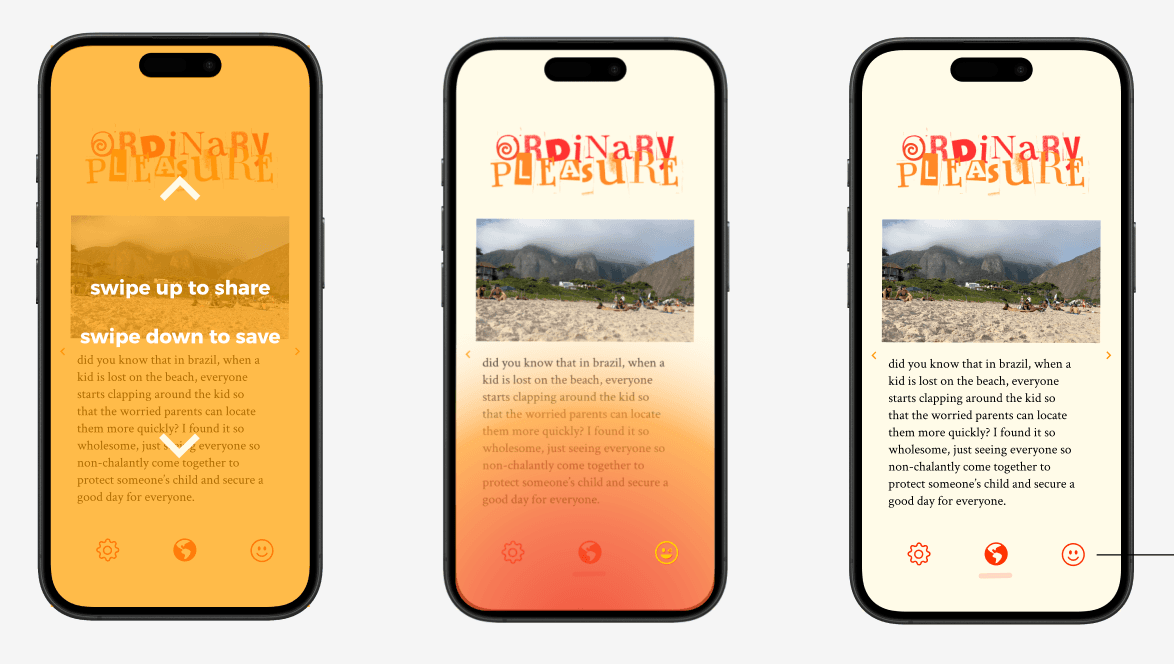
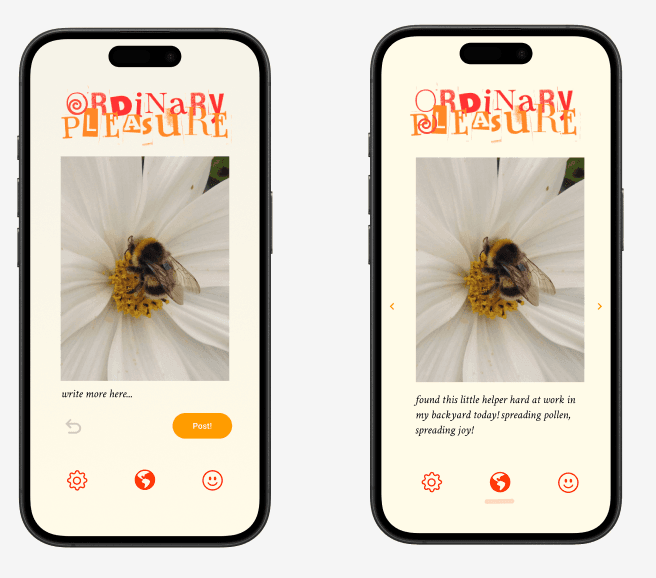
Ordinary Pleasures is a mobile app for capturing the small things that make a day feel alive: a bee at work in a flower, a small act of kindness, or something beautiful that would otherwise disappear without ceremony.
I conceived, designed, and built the prototype to explore one product question: can a social app sharpen a person's attention without competing for it?
Role
Product concept, UX, visual direction, and AI-assisted build
Format
Mobile social product
Status
Self-built prototype
Core rule
Share one. Receive five. Return to life.
WHY I MADE IT
An ordinary pleasure is anything in your day that brought you joy, inspired you, grounded you, or moved you. These moments are often tiny and almost embarrassingly ordinary, which is exactly why they are easy to miss.
Most digital products train attention toward urgency, productivity, comparison, or performance. Even reflection can become another task to complete. I wanted to make something that asked for a moment of attention and then gave the person their day back.
Gratitude usually asks us to evaluate life from a distance. Ordinary Pleasures asks us to notice it while we are still inside it.
The product should return you to your life, not become your life.
THE PRODUCT RULE
The product is organized around a deliberately finite exchange. A user contributes one ordinary pleasure, receives up to five pleasures from other people, and then the session ends.
There is no reason to keep scrolling. The limit is the product.
That rule gave the idea enough structure to become more than a mood or a visual concept. It shaped the contribution flow, the feed, the gestures, and the decision to leave out many familiar social-product mechanics.
TWO PRINCIPLES
01
BEAUTY IN BANALITY
A life becomes more beautiful when a person learns to recognize what is already happening inside it. Ordinary Pleasures creates a small container for practicing that recognition.
02
FOLLOW-THROUGH
Noticing is only the first step. The user pauses long enough to capture the moment, give it language or form, and pass it to someone else.

HOW IT WORKS
A pleasure can begin as a note, photograph, short video, or voice recording. The format matters less than the act of stopping long enough to recognize the moment.
Sharing one pleasure unlocks a small set of pleasures contributed by other people. A user can save something they want to return to or pass it onward, but there is no infinite feed waiting underneath it.
The experience is social without asking the user to perform for an audience. It should feel closer to handing someone a small observation than broadcasting a life.
01
NOTICE
Something ordinary interrupts the day in a good way.
02
CAPTURE
Record it through text, a photograph, a short video, or a voice note.
03
SHARE
Contribute one pleasure to enter the exchange.
04
RECEIVE
View up to five pleasures shared by other people.
05
RETURN
Save or pass along what matters, then leave the app and go back to the day.
A SOCIAL PRODUCT WITH AN EXIT
The hardest product decision was also the simplest: the app needed to end.
Most social products treat leaving as failure. Their feeds are built to remove natural stopping points. Ordinary Pleasures depends on the opposite idea. A complete session should feel satisfying precisely because there is nothing else demanding attention.
Contribution also comes before consumption. The user offers something before receiving something. That keeps the experience reciprocal and makes the feed feel earned rather than passively available.
The prototype does not center streaks, visible popularity, follower counts, or an endless archive of content. Those mechanics would make the product easier to recognize as a social app, but less faithful to the reason it exists.
KEY PRODUCT DECISION
Optimize for a completed ritual, not time spent.
VISUAL DIRECTION
I wanted Ordinary Pleasures to feel warm, a little unruly, and handmade. The identity needed enough personality to avoid looking like a clinical wellness tracker, while leaving the actual pleasure at the center of the screen.
The orange, coral, and cream palette makes the product feel alive without becoming polished in the way social media often demands. The irregular wordmark gives it the feeling of a small independent publication or a note made by hand.
The interface uses simple gestures and generous space so that a photograph or a short piece of writing can remain the main event.

FROM IDEA TO PROTOTYPE
The project began as a question about attention, which meant the first challenge was turning an emotional premise into a product rule clear enough to build.
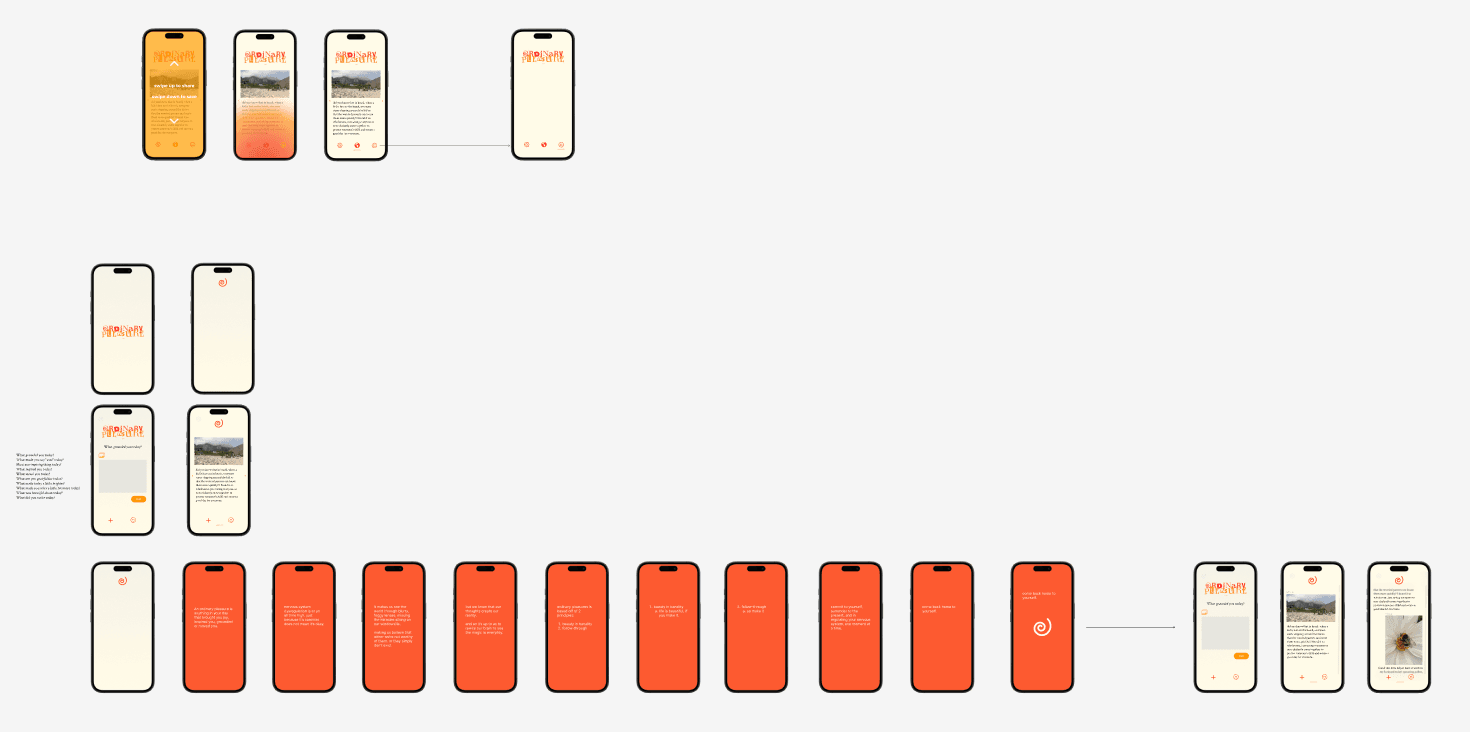
I mapped the journey from onboarding through capture, contribution, receiving, saving, sharing, and returning. The work became less about adding features and more about protecting the central constraint as the product took shape.
AI-assisted development allowed me to move from concept and screen flows into a prototype, test the coherence of the experience, and make product decisions through the act of building rather than stopping at a speculative deck.
WHAT I WOULD TEST NEXT
The concept is intentionally restrictive, which means the restrictions need to feel meaningful rather than punitive. These are the first questions I would test with real users:
01
Does contributing before receiving create reciprocity, or does it create too much friction?
02
Is five the right number of pleasures for a session to feel complete without becoming a feed?
03
Which formats create genuine intimacy, and which begin to feel performative?
04
Do saved pleasures become worth returning to, or does saving undermine the product's emphasis on the present?
These are proposed validation questions, not claims about completed user research or product performance.
WHAT I LEARNED
Building Ordinary Pleasures clarified that a product constraint can be the product strategy. The core loop, share one, receive five, leave, only works because it refuses the endless-feed logic of conventional social products. The limitation was not something to design around. It was the reason the product existed.